DYING AND DEATH ARE EVERYWHERE

I’ve been running into dying and death everywhere.

The unexpected and shocking death of a friend, not close but present in my life for over fifteen years, still unsettles me, forcing me to ponder how life can take such twists and turnings.

As I often do, I seek wisdom through reading, discovering The Wild Edge of Sorrow: Rituals of Renewal and the Sacred Work of Grief by Francis Weller. He emphasizes the crucial role that enlivening ritual can play in our lives, how far we are from incorporating life giving ritual into the fabric of our lives, and the cost of our soul’s disconnection to others and to the creation. I am challenged once again to incorporate ritual more intentionally. I pause in this writing to light the candle I keep beside my computer and to hold my clear glass archetypal Jerusalem cross to my heart, inviting the Great Spirits of Earth, Air, Fire and Water to guide me. Writing faithfully is one of the meaningful rituals which I neglect at great cost to my soul.

I am also reading Being Mortal: Medicine and what matters in the end by Atul Gawande during this week of the anniversaries of the deaths of my late husband 14 years ago and of my mother 41 years ago. Once again I am experiencing the mystical nature of their living and of their dying which deepens my understanding of, connection with, and love for them. Their presence is alive in me and supports and encourages me to write. Being Mortal affirms this remembering and reminds me of the crucial need to bring consciousness/awareness to our intentions for living fully  and of our preparing to live well into our dying.

Watching the DVD/youtube video “Griefwalker”, pushed me further into considering the choices we have about how we live and how we can accompany people who are encountering dying and death. Canadian Stephen Jenkinson, the Griefwalker who was theologically educated at Harvard Divinity School, believes that we cannot love life if we do not embrace death. This is a haunting, poetic depiction of encounters with and conversations about dying and death–and life.

I think of Ira Byock’s The Four Things That Matter Most: A Book About Living recommended by the hospice social worker when my older brother was dying of pancreatic cancer. The four things: “Please forgive me,” “I forgive you,” “Thank you,” and “I love you.” Words that define a courageous and cleansing process for both the person dying and those who care about that person.

I will come back to my interest in living well into dying in future blogs. In the meantime, I invite responses of any length so that I continue to write in the company of others. Thank you.

copyright, Joy Anna Marie Mills, 2016


I’m Back!

Samuel Beckett: “Not to say, not to know what you want to say, not to be able to say what you think you want to say, and to never stop saying, or hardly ever, that is the thing to keep in mind, even in the heat of composition.”

It has been frightening to be so far away from myself–and here I am ready to write again, to nourish my soul by responding to its desire for reflection, contemplation and expression by sharing with you.

Shortly after making the commitment to this website/blog, I realized doing so would be more daunting than I had expected. As a child, I learned that to speak what I experience and believe is dangerous.   No matter how much I wanted to live differently, my lifetime modus operandi has been to start speaking and then to hold back on going deeper to the nub of my belief. The childhood experience of observing the devastating outcome of speaking the truth continued to echo, thwarting my desire to speak my truth fully and completely.

Over these past two months I have continued to struggle with staying focused on this desire. I have consulted with a psychiatrist who is working with menopausal women who have lost their focus and ability to attend to a task, instead going from one activity to another mindlessly. Last week I agreed to take Vyvanse (Google study at Penn re women and menopause focus and attention issues) on a trial basis to see if this would help me maintain my focus and attention on my desired task.

On the exact same day, I worked on a dream with my Jungian dream analyst. In no uncertain terms, the dream said I needed to tap into the spontaneity that I had as a child–the energy that was drained out of me by my mother’s confrontation with her father which led to her being disinherited and her subsequent decision to fight this change to his will all the way to the State Supreme Court. (I plan to eventually include this story “Living beyond Evil.” under the Living into Our Dying website tab.) Although we lived in my grandfather’s house, I have no conscious memory of this fighting, nor my mother’s determination which turned to devastation when she lost the case.  However, it has lived on in my unconscious; my inheritance has been to be terrified to do fully what she had dared to do–to go to the outer limits to fight injustice.

Now I am consciously defying that silencing voice, even by telling you the bare bones of this story. Over the past 14 years since my late husband’s death, I have written 56,000 words of a memoir about his dying, our relationship, and shifts in our spirituality. Now I realize instead of struggling to construct a literary memoir, I want to begin by publishing pieces on this website. I am discovering that to let unfold what wants to unfold is one function of my doing this website and blog. The dream also made clear that I had to mark out the time from 9-12 every day possible (I usually work on Monday and Tuesday morning) so that I can stay faithful to my desire/my calling at this time in my life.

My two major topics and tabs on my website are DARING Faith and Living Well into Our Dying. In my blog I began by focusing on the former since I was attending The Parliament of World Religions. Then I hit a roadblock. Everything in my conscious mind stopped wanting to write, even remembering to write. Now forces conscious and unconscious have combined to say, “If not now, when?” And my attention has shifted for the time being to Living into Our Dying.

Thank you for bearing with me through this hiatus.


I will not give you the gift of hating you.

You have obviously sought it but responding to hatred with anger would be to give in to the same ignorance that has made you what you are…. I have no more time to waste on you. ~~Antoine Leiris, 35, husband of woman killed in the Bataclan massacre

I encourage you to listen to the remarkable and courageous 2 ½ minute video of this man’s open letter to ISIS. There are many versions on the Internet including telegraph.co.uk. The video has gone viral on YouTube. His decision not to hate the killers  gives him the freedom to honor his wife. He is choosing to live as well as to grieve fully and by choosing to raise their 17 month old son lovingly. He does not sidestep the grief he feels; however, he refuses to let the terrorists win by using his time and energy hating them. The entire letter further explains his reasoning and choice of response.

Through the days of sorrow and perplexity since the terrorists attacks on Paris, I have listened to and read many reports and stories. This young widower’s response is the response I was hoping to find, a response which turns knee-jerk reactions on their head. A response which opens us up to a depth of feeling beyond the desire for revenge that escalates the hatred, violence and war in the world. A response which does not condemn refugees and migrants. A response which provokes us to think “Is this a viable starting point for seeking a way to a more peaceful and compassionate world? A way to begin to slow down the reactive demands to meet violence with violence?”

I am wondering what your response to him might be. I am wondering how his words might have sparked your thinking.

What I have learned so far

Learning to blog and maintaining a website have set me on a steep learning curve. It has also demanded that I do important inner work to free myself to say what I believe and experience in my life and in this world. There are the intricacies of creating the website and learning about blogging–which I have done in close consultation with a pro. Then there is discovering how often I can commit to writing new blogs. There is deciding what articles/essays to include under my website tabs. There is understanding how to use the items under menu under site administrations. Body, mind, and spirit have become involved. It is becoming a bracing experience.

I have become curious about the impact of this writing not only on my readers but also on me. I have learned that it is an unfolding within me as I imagine and contemplate what this blog and website mean to me and my own “living into my dying.” (I have no immediate plans to die; however, I live in the knowledge that death is not “if but when.”) I can plan an eight part series on “Biblical Stories of Women”, but I cannot guarantee when the next blog on this topic because new events, concerns or ideas often intervene.

This weekend the tension in the world has intensified. Perhaps you struggle as I do to discern and discover how the horror of the terrorist attacks in Paris impact our lives and our worldview. I ask: is what I am doing making a positive difference? I think back to the sense of comfort I had attending The Parliament of the World’s Religions in Salt Lake City in October (see recent blogs), feeling as though I was among 9600 friends and well-intentioned people. Langar, the free lunch served daily by people of the Sikh faith, was indicative of the caring and kindness I felt surround us. Now I wonder whether I was safe because the world took little notice of our meeting–similar to the way I felt at the Fourth World Conference on Women in Beijing 1995. The only security I encountered was the Imam of Mecca surrounded by his own security team. I was shocked and then saddened when I realized that perhaps that is the only way he can travel in a world with no truly ‘safe zones.”

Doing this writing is exciting and challenging, the way I want to continue to live my life, open to welcome and unwelcome surprise, hard questions, life-enhancing adventures and relationships. Relationships: I hope to be doing this work in community with you and others; your involvement and contributions through comments and reflections are essential for this to become an interactive,lively, enterprise. Thank you for joining me.

Inaugural Women’s Assembly PWR 2015: part 1

This Inaugural Assembly was borne of women speaking up often and persistently after the 2009 PWR in Melbourne where women realized how few women were plenary speakers and workshop leaders. The Inaugural Women’s Assembly gathered 3000 women plus interested men from 9 to 5 before the opening ceremony of the Parliament at 6:30 that evening. The Assembly was described as providing “an important opportunity for women to address and discuss two areas of vital interest: the responsibility of the world’s religions to affirm women’s dignity and human rights, and religious and spiritual inspiration for women’s empowerment.”

Perhaps a hundred of SHEROES drummed us into the Inaugural Assembly, moving through the crowd and ending up on the stage. Self-described: A SHERO is an ordinary Woman that finds the STRENGTH to Endure and Preserve in SPITE of Overwhelming Obstacles. A Role Model to those around HER. With their rhythmic heart beat drumming, they invited us into a women-energized space.

Throughout the morning plenary, we heard from diverse women from around the world, each from a different faith expression. Each woman spoke from her heart for five minutes, sharing the microphone equally, a hallmark of each of the PWR’s plenaries. What I report here is a mere shadow of what was spoken; I took incomplete notes, often lost in what I was hearing. I encourage you to Google: PWR Inaugural Women’s Assembly or Women’s Initiative or Focus on Women to explore the sites that interest you. Here I will paraphrase the points I jotted down.

An Indigenous Grandmother with the Intercontinental Indigenous Peoples Delegation: We are all indigenous to the earth. What will you say when you are asked by the next generations: what did you do to help save the earth, air water?

Ilyasha Shabazz, Malcom X’s daughter: This is a time for building bridges, a growing up time. Children need to understand purpose and power.

Mallika Chopra: State your intention and believe it will happen.

Diana Butler Bass: Women can be spiritual revolutionaries. Rules keep us from being fully human. Look it up for ourselves to encounter God for ourselves. See more beautiful ways.

Maori Grandmother, Dr Rangimarie Turuki Ankirangi Rose Pere: We are the sowers of the sacred seed of knowledge and peacekeepers. Live the Four Directions. The Divine Source is unconditional Love. You are me and I am you. I come in from the future. Separation and division are our worst enemies.

Jean Shinoda Bolen:I feel the heartfulness that fills this room. We can become who we want to be by becoming one with ourselves on a deeper level within. We are the displaced within religious communities. Hillary Clinton said 20 years ago at the Fourth World’s Conference on Women that “Women’s rights are human rights and human rights are women’s rights.” Circles, like campfires, offer the possibility that each person is equidistant from the others and offer a spiritual center and a place to tell your story. The spirituality unites; religions divide.

Ruth Messinger: 70% of the extremely poor are women; one in four has been or will be abused; fourteen million women are force into early marriages. One in three women are assaulted. These assaults are soul damaging and deadly. We have a broken moral compass. In 1948 the UN proclaimed Women’s Rights. How we treat women is the way we treat the earth. When we uplift women, children thrive.
To be continued

A General Reflection on my Parliament of the World’s Religions (PWR) Experience

The PWR attracted over 9600 people and offered more than 300 workshops; several sacred spaces; exhibitions; all day small stage performances with music and dance from many cultures; open space activities in addition to the all-encompassing plenaries focusing on the six major concerns of this PWR. I want to emphasize that by the nature of the enormous diversity of choices, my experience was narrow and limited. I constantly had to make choices about what workshops to attend. I focused mostly on The Women’s Initiative which wove workshops throughout the five days. I discovered that I could not sustain a 12-14 hour day of active participation and spent a couple hours each day resting and absorbing what I had seen and heard. In addition, I attended only four out of the five days, departing the morning of the fifth day in order to be able to attend my writing seminar in Washington, D.C. two days later.

For a fuller understanding of the PWR I encourage you to go to the website: ParliamentOfReligions.org/watch and follow whatever interests you.The videos capture some of the delightful flavor of walking through the Salt Palace feeling the sense of co-operation and peace among the participants. It is humbling to me to realize how small a slice of the Parliament I actually experienced as well as how marvelous it was to participate in this historic gathering. My hope is that these posts and the website might spark your interest and you become involved in Interfaith Now in a way that mirrors your interest.

My next post(s) will include my reflections on the Women’s Assembly and the Focus on Women, followed with a post on my experience with the Indigenous presence at the Parliament. Then I will return to my posts on Biblical Stories of Women.

The Parliament of the World’s Religions (PWR) 2015: Reclaiming the Heart of Our Humanity – Working Together for a World of Compassion, Peace, Justice and Sustainability

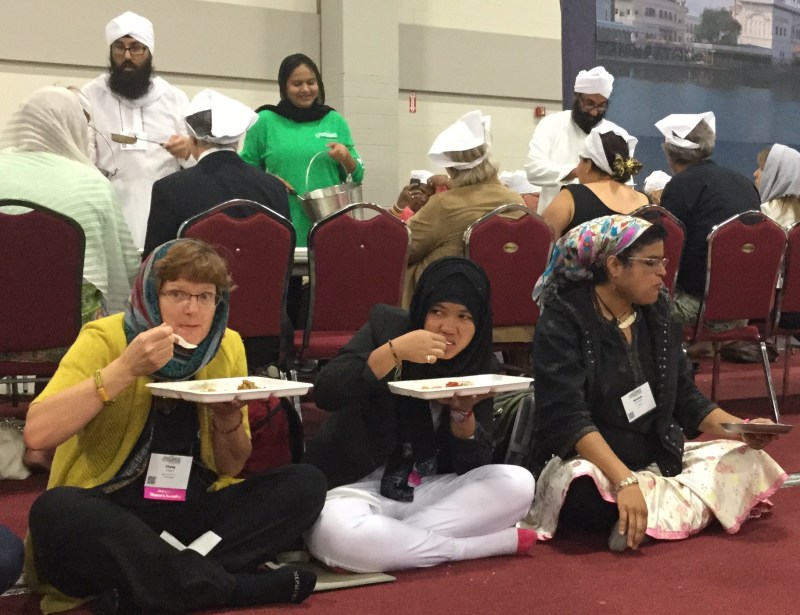
Langar: “Regardless of who you are, where you come from, what your background is, you’re welcome into this space.” This faith statement of the Sikh religion was lived out at the sixth Parliament of the World’s Religions: The Global Interfaith Movement, in Salt Lake City for five days in mid-October. Langar: the radical hospitality of the Sikh faith fed a full meal to up to 6000 people a day. At no cost, with no “free will offering” buckets, with great dignity and humble kindness.

As we entered the huge hall, each of us was greeted by women dressed in the traditional Sikh white pants and long tunic. Asked to remove our shoes, we placed them on a numbered bookcase, memorizing the number for retrieval later. Then I joined one of two long lines to wait my turn. The first day, I assumed the wait would be long and my friend and I chose not to wait. The second day, I realized this was a mistake: the lines moved swiftly as people finished their meals and left. No one hurried us–there was enough time and food for every one.

Before we were seated cross-legged in long rows on the thinly carpeted floor, if our heads were not already covered, we were given a white bandanna to cover our heads in order to honor our partaking of this meal which had already been blessed. Most servers wore either a white turban or white head covering. There was a long line of tables with chairs for those who needed to sit in order to partake of the meal. As I sat down, I took in our diversity which included people from up to 50 faith expressions and subsets, including Muslims, Christians, Jews, Sikhs, Jains, Zoroastrians, Baha’is, Yorubas, Quakers, Native Americans, Pagans, Buddhists, Hindus and Wicca. Sitting together on the floor and breaking bread together, we were “all equal before God,”no matter what our faith background was, as one Sikh explained the purpose of Langar.

Photo Oct 17, 4 15 53 PM

GUESTS WITH HEAD COVERS BEING SERVED AT LANGAR BY SIKH HOSTS

First, we were given a rectangular Styrofoam plate with dividers, napkins, a spoon and a plastic glass. The servers were all ages, from older men and women in traditional garb and turban-covered heads to youngsters eager to serve us as their elders were. They were joined by volunteers. Adults carried large stainless steel buckets full of a plentiful variety of food: a vegetable curry, raita, rice and salad. The children served us nan bread, made sure we had enough water or mango lassi to drink, and served the fruit as the meal ended. Second servings were graciously offered. Then we were guided to the dessert area!! where we were also given a choice of tea to savor with the dessert. Meanwhile, a volunteer, using a portable electric vacuum, cleaned the space we had occupied so that the next recipient of this blessed meal could be seated. My remembrance of this Sikh generosity offered with humility fills me once again with gratitude and continues to enrich my faith in the peoples of the world. The community represents the hope of our survival found when we talk and take loving action across our differences.

Langar also exemplified the theme of the Parliament 2015, “Reclaiming the Heart of Our Humanity – Working Together for a World of Compassion, Peace, Justice and Sustainability.” In delightful harmony more than 9600 people attended the hundreds of events and exhibitions over the five day period. As I re-member the Parliament, I see people from around the world, many in faith tradition defining clothing walking in peace and companionship passed one another headed for a plenary session or one of the hundreds of workshops on endless topics. I wore my clerical collar in order to identify myself as a priest wanting to be in conversation with other attendees. Two other aspects of this Parliament captured my attention and heart: the Inaugural Women’s Assembly held from 9 to 5 before the evening opening ceremony; second, the Native American Ute presence, particularly their tending 24 hours a day each day a ceremonial fire burning in a large stainless steel cauldron at the south entrance to the Salt Palace conference center. I will describe these and other aspects in my next blogs.

Here I want to offer a bit of history. The First Parliament of World Religions was held in Chicago in 1893 during a World’s Fair type of event. This event, attended by 10,000 people over its March to May duration, introduced the leaders of Eastern and Western religions to one another, offering an opportunity to learn about one another’s faith. With smaller gatherings during the next one hundred years, the modern Parliaments began in 1993 with Chicago again hosting the second Parliament, followed by 1999 in Capetown, 2004 in Barcelona and 2009 in Australia. The plan of the Parliament Board is to work toward a gathering every two years, with the particular hope of nurturing and learning from the emerging leaders of our future. To learn more enter Parliament of World’s Religions in your browser. Also ask me questions in the comment space below.

DECLARATION FOR THE DIGNITY AND HUMAN RIGHTS OF WOMEN

This is a long post from The Parliament of World Religions which sets forth some of my reasons for my Biblical Women posts. I will be attending and blogging from The Parliament in Salt Lake City October 15-19, including reflections on the first Women’s Assembly.

Introductory Note:
The following Declaration is intended to elicit the commitment and action of the world’s religious leaders, adherents and institutions to honor and uphold the dignity and human rights of women. It is the critical role of religion as a powerful force of influence on the quality of life experienced by women and girls throughout the world and advocates the moral responsibility of religions in improving those lives. Declarations including the Universal Declaration of Human Rights, the Declaration Towards a Global Ethic issued at the 1993 Parliament of the World’s Religions, the United Nation’s 1979 international treaty (and bill of rights for women) entitled Convention on the Elimination of all Forms of Discrimination Against Women (CEDAW) ratified by 189 States, the UN’s Beijing Declaration and Platform for Action, President Carter’s Call to Action, essays and statements including his presentation at the 2009 Parliament, as well as international religious doctrines and statements of religious founders and leaders, prominent political, women’s, and human rights leaders and activists were reviewed for content and language. The wording of this declaration combines precise language and paraphrasing from these sources as well as original material. A specific list of sources will be available as an addendum.
Care was taken not to use language that reflects any one religious tradition, so that leaders and adherents of all religious traditions and spiritual paths, or none, might support its objectives. This declaration does recommend actions we hope will be undertaken to alleviate the subjugation and suffering of women and girls. It is designed to be universal in scope and inspirational in tone.
The Problem
The struggle for the dignity and equal rights of women is the global human and civil rights struggle of our time. War and violence, economic disparity and impoverishment, environmental damage and its devastating consequences fall disproportionately upon women and girls who also suffer the most prevalent injustices in our world today. Violence, child marriage, slavery and forced prostitution, rape and sexual assault, domestic brutality and abuse, “honor killings” and immolation, bodily and genital mutilation, gendercide of girls and selective abortion of female fetuses, and legitimized murder of women are pandemic.
• Throughout the world, one in three women has been raped, beaten or violently assaulted.
• Seven hundred million women were children when they were married.
• More than one hundred and thirty three million girls and women have experienced some form of female genital mutilation (FGM).
• More than twenty thousand women a year are victims of “honor killings,” usually murdered by their father, uncle, or brother.
Institutions in which women are given little or no voice impose constraints on women’s basic freedoms to control their own bodies, move about freely, own property, choose to marry or obtain a divorce, retain custody of their children, receive an education, work, or have their testimony given equal weight in court. All over the world, they risk being ostracized, abused, or killed if they try to change these unjust conditions. Even where advances toward equality have been made, women continue to suffer disproportionately from poverty and environmental devastation, from violence and abuse, life-damaging discrimination in access to education and health care, the burdens of unpaid care-giving and unequal pay, and the systematic exclusion from decision-making within religious and other institutions that determine the quality of their lives.
These shameful violations of women’s dignity and human rights are based on the false premise that men and boys are superior to women and girls, an outdated view perpetuated by too many religious leaders and adherents who choose to misinterpret or use carefully selected scriptures, texts, and teachings to proclaim the inferiority of women and girls. These harmful and religiously justified beliefs permeate societies and contribute to the pervasive deprivations and abuse suffered by women and girls throughout the world.
As the Elders have advised: “The justification of discrimination against women and girls on grounds of religion or tradition, as if it were prescribed by a Higher Authority, is unacceptable.”
It is time to end these practices and views. It is time to heal the broken heart of humanity’s feminine half.
The Role of Faith in Ending the Subjugation of Women
Being treated justly and with respect should not depend on whether one is male or female. The Universal Declaration of Human Rights and the Declaration Toward a Global Ethic call for the equal rights of men and women, and the teachings of the world’s religions universally call for compassionate and equitable treatment of all—both men and women.
The principle of treating others the same way one wishes to be treated is stated, in one form or another, throughout the religions of the world. We are all interconnected and interdependent and when half the human race suffers, we all suffer. We must all be treated with justice, respect, kindness, and love.
It is impossible to imagine a God, a Divine Source, a Sacred and Ultimate Reality, that is unjust. There is no religion that despises women, for hatred and oppression cannot come from the heart of God, or Goddess, or Holy Mother/Father, nor flow from that which is Divine, the Creator, the One, the Source, the All.
It is impossible to imagine the healthy, sustainable, just, and peaceful world of our collective future without the spiritual wisdom and leadership of women.
Commitments of Conscience
Therefore, we, your grandmothers, mothers, daughters, wives, and sisters, call upon our grandfathers, fathers, husbands, sons, and brothers, and upon each other–upon all people of faith—to alleviate the unwarranted deprivation and suffering of women and girls.
We are mindful of and grateful for leaders, adherents and institutions of faith and those interfaith institutions already fighting for the dignity, well-being, equal status and human rights of women around the globe – but more good work to remains to be done.
We call upon the religions of the world to lead the way in ending violence against women and girls.
We call upon faith and interfaith organizations to work collaboratively with institutions and organizations that are working to advance the well-being, and rights of women around the globe. Furthermore, we call upon the world’s guiding institutions to partner with faith and interfaith organizations working to advance women’s well-being and rights.
We call upon all religious leaders and adherents to challenge and change harmful teachings and practices that justify discrimination and violence against women and girls.
We call upon all religious leaders and adherents to acknowledge and emphasize the positive messages of dignity and equality that the world’s faiths share.
We call upon all religious leaders and adherents to embrace their moral responsibility and collectively commit to ensuring that women are fully and equally involved in decision-making within religions and in every sphere that involves their lives.
We call upon the world’s religions to honor and uphold the dignity, well-being, and human rights of women and girls.
We commit ourselves to this collective undertaking to heal the heart of our humanity by releasing women, girls, men, and boys from the bondage of gender-based discrimination and violence. We do so with hope and with faith in our future.
© 2015 Parliament of the World’s Religions________________________________________

Biblical Stories of Women: Death-dealing or Life-giving?

Justice is what love looks like in public. ~~Cornel West

PART 1
These next blogs are about justice, what love looks like in public, and the “last” taboo: daring to question the patriarchal, traditional, white Western male interpretation of Biblical stories. Daring to propose that God imaged as a man and addressed with male language is unjust. Daring to say that I long to hear my woman name spoken in liturgies and raised up in Bible studies. Daring to proclaim the abuse of women in Biblical stories. Daring to suggest that male-centered language and liturgies are driving people from churches and synagogues. Daring to recommend that we begin to read Biblical stories of women—and of men, once we have considered the stories of women—through a hermeneutic (interpretation) of suspicion, wondering who benefits from the way the stories are written and interpreted and lived out in the world.
In this series, I will begin each blog by challenging you to reflect on two questions. I encourage you to jot down your thoughts before continuing to read the blog. I hope you will discover that your thoughts add to my reflection. I have led studies on many of these stories with over 500 people. Each time there have been fresh insights. Please add your final reflections in the comment area of the blog so that we can enrich our collective knowledge.

Let’s begin with the first two questions.
1. What is your response to what you have read above?
2. When did you recognize male privilege in your life?

The way women and girls are represented and spoken about by the world’s religions has a profound impact on women’s and girls’ sense of their bodies/themselves. Because Western society has been permeated by a patriarchal and male-centered Jewish and Christian ethic, Biblical images of women are ingrained into the collective unconscious in ways often destructive to women’s sense of themselves. In addition, with rare exceptions, Christian and Jewish teaching, preaching, liturgies and theologies continue to image God as male. As a result, women are faced with the ultimate stained-glass ceiling: God is pictured and referred to as a man. The implicit message is that women’s bodies and beings are less acceptable than men’s. The impact of the Godhead depicted as a man has distorted women’s images of themselves, body, mind and spirit. The reverse is also true. Men have a distorted view of their superiority, lording over others being a birth right as well as often burdened by not measuring up to this God-standard.
Christian, Jewish and Muslim teachings and doctrines (as well as those of other faith expressions) that devalue, degrade and dismiss women have resulted in spiritual as well as psychological stress and trauma for millennium. To challenge the pervasiveness of this connection, it is as vital to raise up empowering and life-giving Biblical images of women as it is to proclaim dis-empowering and traumatizing aspects of the Biblical stories of women. Naming narratives which have oppressed women can release blocked energy. Re-imagining narratives which have the power to liberate women can become the creative and redemptive use of that freed energy.

To take your thinking a step further, I encourage you to write down your responses to these questions:
1. What are you thinking after reading the above?
2. What have you learned?
3. What life giving action might you take in response?
These questions will be asked at the conclusion of each part of this series. Thank you.

POPE FRANCIS: Moving the conversation and questions forward

During his visit to the United States, Pope Francis’ gentle and compassionate presence was authoritative without a punishing edge; he called us to take responsibility for the problems facing us as human beings. Specifically Francis challenged people to intentionally address our responsibility for climate change, for the oppressed living in poverty, and for displaced refugees.

My response to his call is to push the conversation forward by raising underlying questions about the foundational images of the world’s major religions which stand in the way of each of these challenges being addressed fully. Considering these questions might deepen our responses to the Pope’s challenges.

How does naming God almost exclusively as male, and imaging “Him” as omniscient (all knowing), omnipotent (all powerful/almighty), and omnipresent (always present) contribute to the problems of climate change, poverty, refugees and religious fundamentalism? How is man’s (literally) treatment of the earth–often called Mother Earth and associated with the fecundity of the female–interwoven with the treatment of women as secondary citizens in most of the world? How does Christianity along with other faith expressions perpetuate this treatment of the Earth and of the oppressed peoples of the Earth by focusing on achieving eternal life in Heaven rather than on the quality of life on Earth? How has the image of a punishing Father God led to the subjugation of some people, particularly of women and their children, by men whose power over others has been sanctioned by male-dominated faith communities?

These are complex questions which lead on to further questions. My desire is to explore these questions and raise new ones in conversation with your responses.

I invite you to begin by pondering Mary Daly’s 1973 proclamation, “If God is male, then male is God.” As you consider her statement, I would like to slow down the discussion by inviting you to read my understanding of several Biblical stories of women in an eight-part occasional series “Biblical Stories of Women: Death dealing or Life Giving?” The original article upon which this series will expand appears under the tab DARING Faith.